Showing posts with label Hens. Show all posts

Friday, July 2, 2010

african animals of purple swamp hens pictures


african animals of purple swamp hens photos

african animals of purple swamp hens photos


free downloading pics of swamphen wiki

pictures of animal purple swamphen diet

different varities of hens youtube

videos of purple swamp hen habitat

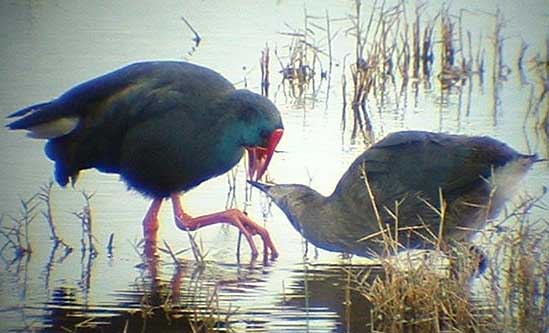
The Purple Swamphen prefers wet areas with high rainfall, swamps, lake edges and damp pastures. The birds often live in pairs and larger communities. It clambers through the reeds, eating the tender shoots and vegetable-like matter. They have been known to eat eggs, ducklings, small fish and invertebrates such as snails. They will often use one foot to bring food to their mouth rather than eat it on the ground. Where they are not persecuted they can become tame and be readily seen in towns and cities.The species has a very loud explosive call described as a "raucous high-pitched screech, with a subdued musical tuk-tuk". It is particularly noisy during the breeding season. Despite being clumsy in flight it can fly long distances, and it is a good swimmer, especially for a bird without webbed feet.

Thursday, February 11, 2010

latest images of animal gray jungle fowl


wallpapers of animal gray jungle fowl

wallpapers of animal gray jungle fowl


 free downloading pics of gray fowl wiki
free downloading pics of gray fowl wiki

 pictures of gray jungle fowl youtube

pictures of gray jungle fowl youtube


african animal gray jungle fowl poster

 different types of fowls habitat

different types of fowls habitat

The male has a black cape with ochre spots and the body plumage on a gray ground colour is finely patterned. The elongated neck feathers are dark and end in a small, hard, yellowish plate; this peculiar structure making them popular for making high-grade artificial flies.The legs are red and the wattles and combs are not as strongly developed as in the Red Junglefowl. Legs of males have spurs and females usually lack them.The central tail feathers are long and sickle shaped. Males have an eclipse plumage in which they moult their colourful neck feathers in summer during or after the breeding season.The female is duller and has black and white streaking on the underparts and yellow legs. They are found in thickets, on the forest floor and open scrub. Their loud calls of Ku-kayak-kyuk-kyuk can be heard in the early mornings and at dusk. They forage in small mixed or single sex groups. They breed from February to May. They lay 4 to 7 eggs which are pale creamy in a scrape. Eggs hatch in about 21 days. Although mostly seen on the ground, Grey Junglefowl fly into trees to escape predators and to roost.
for more pics......

Tuesday, January 19, 2010

wild animals of helmeted guinea fowls information


wild animals of Helmeted Guinea fowl information
wild animals of helmeted guinea fowl information


free downloading pics of helmeted guineafowl

free downloading pics of helmeted guineafowl


nature animals of helmeted guinea fowl for sale

nature animals of helmeted guinea fowl for sale

different types of guinea fowls
different types of helmeted guinea fowls


latest images of guinea fowl farming

latest images of guinea fowl farming
The Helmeted Guineafowl is a large (53-58 cm) bird with a round body and small head. They weigh about 1.3 kg.The nest is a well-hidden, generally unlined scrape and a clutch is normally 6-12 eggs which the female incubates for 26-28 days. Nests containing larger numbers of eggs are generally believed to be the result of more than one hen using the nest; eggs are large and an incubating bird could not realistically cover significantly more than a normal clutch. Domestic birds at least, are notable for producing extremely thick-shelled eggs that are reduced to fragments as the chicks hatch, rather than leaving two large sections and small chips from where any chick has removed the end of the egg. The chicks are cryptically coloured and rapid wing growth enables them to flutter onto low branches barely a week after hatching. These guineafowl live as long as 12 years in the wild.

Friday, January 8, 2010

nature animals of vulturine guinea fowl gallery


nature animals of vulturine guinea fowl bird

nature animals of vulturine guinea fowl bird


 free downloding of baby vulturine guinea
free downloding of baby vulturine guinea

pictures of vulturine guinea fowl

different types of birds youtube

 a group of vulturine guinea fowl photos
a group of vulturine guinea fowl photos
It breeds in dry and open habitats with scattered bushes and trees, such as savannah or grassland. It lays its usually 4-8 cream-coloured eggs in a well-hidden grass-lined scrape.
Vulturine Guineafowl is a large (61-71cm) bird with a round body and small head. It is longer in the wings, neck, legs and tail than other guineafowl. The adult has a bare blue face and black neck, and although all other guineafowl have unfeathered heads, this species looks particularly like a vulture because of the long bare neck and head.
The slim neck projects from a cape of long, glossy, blue and white hackles. The breast is cobalt blue, and the rest of the body plumage is black, finely spangled with white. The wings are short and rounded, and the tail is longer than others in the family Numididae.
The sexes are similar, although the female is usually slightly smaller than the male and with smaller tarsal spurs. Young birds are mainly grey-brown, with a duller blue breast and short hackles.
for different pics...

Tuesday, December 22, 2009

indian animals of collared scops owl pictures


indian animals of collared scops owl pictures


free downloading pics of scops owl wiki

free downloading pics of scops owl wiki

wild animals of  indian scops owl youtube
wild animals of indian scops owl youtube


different types of white faced scops owl

different types of white faced scops owl


a group of african scops owl habitat

a group of african scops owl habitat
The Purple Swamphen breeds in warm reed beds. The male has an elaborate courtship display, holding water weeds in his bill and bowing to the female with loud chuckles.
In the western parts of the range the pattern of social behaviour tends to be monogamy, but cooperative breeding groups are more common in the eastern parts of the range.
Pairs nest in a large pad of interwoven reed flags, etc., on a mass of floating debris or amongst matted reeds slightly above water level in swamps, clumps of rushes in paddocks or long unkempt grass.
Multiple females may lay in the one nest and share the incubation duties. Each bird can lay 3–6 speckled eggs, pale yellowish stone to reddish buff, blotched and spotted with reddish brown.
A communal nest may contain up to 12 eggs. The incubation period is 24 days.
for different images...

Get latest Animals Pics & Photos

Enter your email address:

Delivered by FeedBurner