Wednesday, April 6, 2016

wallpaers of animal northern tamandua collection


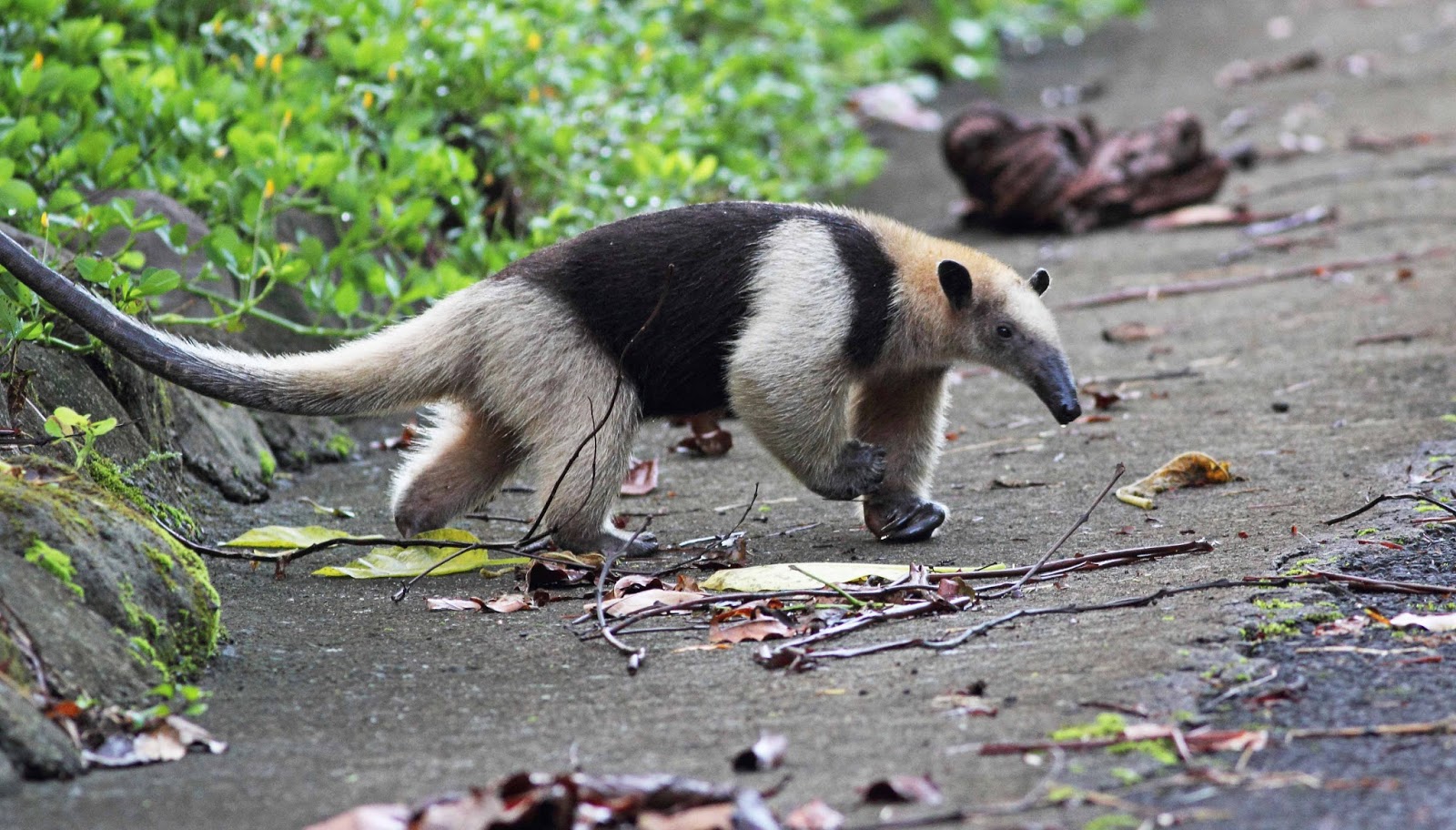
The northern tamandua lives mostly in southeastern Mexico south throughout Central America, and in South America west of the Andes from northern Venezuela to northern Peru.It found northern Argentina, southern Brazil and Uruguay.This animal have tapered heads with a long, tubular snout, small eyes, and protruding ears. Their tapered mouths house a tongue reaching upwards of 40 cm (16 in) in length. The tail is hairless and pink in color, marked with an irregular pattern of black blotches and the forefeet possess four clawed digits, the third digit bearing the largest claw, while the hind feet have five digits.Their fur is thick, bristly, yellowish-white to fawn in color, often with a broad black lateral band, covering nearly the whole of the side of their bodies.

The tamanduas are nocturnal, active at night and secreting away in hollow tree trunks and burrows abandoned by other animals during daylight hour and they spend up to half of their time in the treetops, as much as 64%, where they forage for arboreal ants and termites. This animal move rather awkwardly on the ground and are incapable of galloping like their relative, the giant anteater. Tamanduas walk on the sides on their clenched forefeet to avoid injuring their palms with their sharp claws.It manufacture a potent musk in their anal glands which they use for marking territory. They smear the strong smelling secretions on rocks, trees, fallen logs, and other prominent landmarks to announce their presence to other tamanduas.When threatened while in the trees, the tamandua will firmly grasp the branch with its hind limbs and tail and rear up to confront its attacker with slashing motions of its large, curved claws. When on the ground, it will protect its vulnerable hindquarters by backing against a tree or a rock and lashing out with its forearms.

These animals have small eyes afford limited vision. Instead of relying on their sense of sight, they primarily utilize their senses of smell and hearing to locate their insect prey. They use their sharp claws and powerful forearms to tear open the nest of a colony of termites and employ their elongated tongues, coated with sticky saliva, to extract the insects. for more pics....

Tuesday, March 29, 2016

pictures of different animals orangutan information


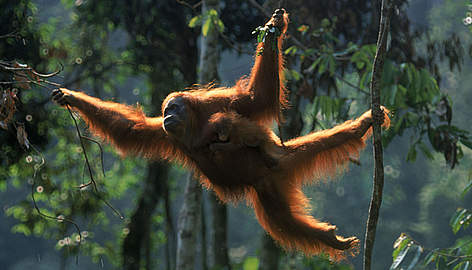
The orangutans are the two exclusively Asian species of extant great apes. Native to Indonesia and Malaysia, orangutans are currently found in only the rainforests of Borneo and Sumatra.These animals are the most arboreal of the great apes and spend most of their time in trees. Their hair is typically reddish-brown, instead of the brown or black hair typical of chimpanzees and gorillas. Males and females differ in size and appearance. Dominant adult males have distinctive cheek pads and produce long calls that attract females and intimidate rivals.

Orangutans live in primary and old secondary forests, particularly dipterocarp forests and peat swamp forests. Both species can be found in mountainous and lowland swampy areas. Sumatran orangutans live at elevations as high as 1500 m (4921 ft), while the Bornean orangutans live no higher than 1000 m (3281 ft). Other habitats used by orangutans include grasslands, cultivated fields, gardens, young secondary forest, and shallow lakes. Orangutans are the most arboreal of the great apes, spending nearly all their time in the trees.The most of the day is spent feeding, resting, and travelling. They start the day feeding for 2–3 hours in the morning and they rest during midday then travel in the late afternoon. When evening arrives, they begin to prepare their nests for the night. Orangutans do not swim, although they have been recorded wading in water. The main predators of orangutans are tigers. Other predators include clouded leopards, wild dogs and crocodiles. The absence of tigers on Borneo may explain why Bornean orangutans can be found on the ground more often than their Sumatran relatives.

Orangutans are opportunistic foragers, and their diets vary markedly from month to month.Fruit makes up 65–90% of the orangutan diet, and those with sugary or fatty pulp are favoured. Ficus fruits are commonly eaten and are easy to harvest and digest. Lowland dipterocarp forests are preferred by orangutans because of their plentiful fruit. Bornean orangutans consume at least 317 different food items that include young leaves, shoots, bark, insects, honey and bird eggs.
for different birds.....

Friday, November 6, 2015

nature animals of malabar grey hornbill pictures

The Malabar grey hornbill is a large bird, but mid-sized for a hornbill, at 45 to 58 cm (18 to 23 in) in length. It has a 23 cm (9.1 in) tail and pale or yellowish to orange bill.Males have a reddish bill with a yellow tip and the females have a plain yellow bill with black at the base of the lower mandible and a black stripe along the culmen. They show a broad whitish superciliary band above the eye, running down to the neck. They fly with a strong flap and glide flight and hop around heavily on the outer branches of large fruiting trees. They have brown-grey wings, a white carpal patch and black primary flight feathers tipped with white. The Indian grey hornbill, which is found mainly on the adjoining plains, is easily told apart by its prominent casque, and in flight by the white trailing edge of the entire wing. These grey hornbill has a grey back and a cinnamon vent. The long tail is blackish with a white tip, and the underparts are grey with white streaks. The long curved bill has no casque. Immature birds have browner upperparts and a yellow bill. Young birds have a dull white or yellow iris.

The grey hornbill loud calls are distinctive and include "hysterical cackling", "laughing" and "screeching" calls.They are found mainly in dense forest habitats, the thinner dry forest habitat of the plains is typically occupied by the Indian grey hornbill. This hornbill is found in small groups mainly in habitats with good tree cover and being large frugivores, they are important as seed dispersal agents for many species of fruit bearing forest trees.They also feed on small vertebrates and in captivity they will readily take meat.To see funny pics....

Thursday, August 6, 2015

wallpapers of animals white cairn terrier puppies


The Cairn Terrier has a harsh weather-resistant outer coat that can be black, cream, wheaten, red, gray, or brindled in any of these colours. Pure black, black and tan, and white are not permitted by many kennel clubs.These puppies are shed very little but should always be hand stripped.If done incorrectly this can cause discomfort to the dog, causing it to shy away from future hand stripping. Removing the dead hair in this manner allows new growth to come in. This new growth helps protect the dog from water and dirt.

Cairn Terrier ancestors are from Scotland, where the wire coat repels water and keeps the dog dry even in rainy or damp climates. Keeping the Cairn Terrier coat in its original state will prevent possible skin irritations. As dead hair is removed by stripping the coat, new growth comes in and the skin and coat will remain healthy. Clipper-cutting a Cairn might destroy the protective wire coat unique to this breed.It is wise to have a pet examined to rule out heritable skin diseases if a Cairn is obtained from unknown sources (i.e. pet stores, rescues, or puppy mills).This puppy Weight is 10-16 pounds (4.5-6.8 kg) and Height is 9–13 inches (23–33 cm).These dogs are generally healthy and live on average about Life span is 12–17 years and Litter size is 2-10.To see more pics.....

Tuesday, July 28, 2015

wallpapers of bird red bellied woodpecker collections


The red-bellied woodpecker is a medium-sized woodpecker of the Picidae family. It breeds in southern Canada and the northeastern United States, ranging as far south as Florida and as far west as Texas.The adults are mainly light gray on the face and underparts, they have black and white barred patterns on their back, wings and tail. Adult males have a red cap going from the bill to the nape and females have a red patch on the nape and another above the bill. The reddish tinge on the belly that gives the bird its name is difficult to see in field identification. These birds are 22.85 to 26.7 cm (9.00 to 10.51 in) long, and have a wingspan of 38 to 46 cm (15 to 18 in).

Red-bellied woodpeckers are noisy birds, and have many varied calls. Calls have been described as sounding like churr-churr-churr or thrraa-thrraa-thrraa with an alternating br-r-r-r-t sound. Males tend to call and drum more frequently than females, but both sexes call. Often, these woodpeckers "drum" to attract mates. They tap on aluminum roofs, metal guttering, hollow trees and even transformer boxes, in urban environments, to communicate with potential partners. Babies have a high-pitched begging call of pree-pree-pree. They will continue to give a begging call whenever they see their parents for a while after fledging.These birds mainly search out arthropods on tree trunks. They may also catch insects in flight. They are omnivores, eating insects, fruits, nuts and seeds. Their breeding habitat is usually deciduous forests and nest in the decayed cavities of dead trees, old stumps, or in live trees that have softer wood such as elms, maples, or willows, both sexes assist in digging nesting cavities. Areas around nest sites are marked with drilling holes to warn others away,It depends on large trees for nesting. In areas that are extensively deforested, the birds will sometimes utilize gardens, but for the most part simply will not be present in any numbers.
The red-bellied woodpecker expresses foraging behavior by catching or storing food. This woodpecker uses its bill for foraging as a chisel drilling into bark or probing cracks on trunk of trees.In this manner, the red-bellied woodpecker is able to pull out beetles and other insects from the tree with the help of its long tongue.This behavior is also seen for storing food from other animals by hiding food behind bark or deep in cracks of a tree.

Thursday, April 9, 2015

latest photos of black indian runner duck collections


Indian Runners don’t waddle like other ducks – they live up to their name and run. They were selected as ‘walking ducks’ in the Far East and evolved a slim, upright body and elongated thigh bone. When foraging or relaxed their posture is flat, but they stand upright to move quickly. In the show pen they are judged on their pure colour, overall stance and shape (type). They must have a keen Runner head, slim shoulders and the typical ‘hock bottle’ shape. They are a light-weight breed of duck at 1.6-2.3kg (3.5-5lb) for drakes and 1.4-2 kg (3-4.5lb) for ducks. Drakes stand around 58-70cm (23-28 in) in height and need a tall show pen,ducks are 60-70 cm (20-24 in.).The food and housing are similar to other ducks, but these birds like space to forage. They also need a secure garden area to start them off – otherwise they can run off in unfamiliar surroundings. This black indian runner ducks are plumage black with a beetle-green lustre throughout and the eyes are dark brown, bill is black.The wings will be black with a beetle-green sheen and underwing dark grey,these ducks legs and webs as black as possible and orange shading permitted in older drakes.The female ducks eyes will be in stripes and life span of this duck 4 to 12years.
To see more pics...

Wednesday, March 18, 2015

latest pictures of fantail pigeons collections

The Indian Fantail is a breed of fancy pigeon developed over many years of selective breeding. Indian Fantails, along with other varieties of domesticated pigeons are all descendants from the rock pigeon.The keepers at the San Diego Zoo who had obviously never seen Indian Fantail pigeons before were so taken by their distinct looks that they decided to keep, and later breed and develop them. It was from these two lucky birds that the species of Indian Fantail pigeons spread beyond Indian shores and reached the farthest corners of the world.

The Indian Fantail pigeon is a breed of fancy pigeon,the doves originated in India. These birds are well known for their beauty and their fan shaped tail makes them different from other pigeon breeds. They are bigger in size than the English Fantail pigeon. The indain fantail doves are also known as homing doves. People usually keep these pigeons because they make the beauty of their home. They do give eggs in similar pattern as other pigeons do. Usually gives birth to 2 or 3 baby doves at a time and the baby doves takes at least 4 to 6 weeks to fly and leave their home. Usually a breeding pair can lay eggs around or after 21 days from the first hatch. Indian Fantail pigeons are most commonly white with light tan spots, although breeders have introduced more new colours. They have a fan-shaped tail and their feet are covered in feathers. Their average weight is 13 ounces (369 g) and their average length is 11 inches (28 cm). It is interesting to note that the birds walk on their toes. The chest is carried upright so that it is higher than the bird’s head, which rests back on the cushion formed by the tail feathers.for different pics....

Tuesday, December 23, 2014

beautiful pictures of blue magpie birds gallery


The red-billed blue magpie is a species of bird in the crow family Corvidae. It is about the same size as the European magpie but has a much longer tail, the longest tail of any corvid. It is 65–68 cm (26–27 in) long and weighs 196-232 grams.The bird head, neck and breast are black with a bluish spotting on the crown. The shoulders and rump are a duller blue and the underparts are a greyish cream and the long tail is a brighter blue (as are the wing primaries) with a broad white tip. The bill is a bright orange-red as are the legs and feet and a ring around the eye. This red can vary across its range to almost yellow in some birds and food is sought both in trees and on the ground. It takes the usual wide range of food, such as invertebrates, other small animals, and fruit and some seeds. It robs nests of eggs and also chicks.

The blue magpie is unafraid of people. Their traces can be found in proximity to human residences in the mountains or newly cultivated lands. They are gregarious and are usually found in groups of six or more, gliding and shuttling in the woods. When flying in a group, the birds tailgate each other. Sometimes they may be seen strung out as if in line and it was a high pitched cackling chatter, "kyak-kyak-kyak-kyak". Females incubate eggs while males help out with nest building and feeding. Their nests are usually found in the woods and weeds rendezvous areas and are mostly built on higher branches from March to April. The nest shapes like a bowl and is weaved with twigs and weeds,usually there are 3–8 eggs in a clutch. Eggs are olive green in color, with dark brown marks. Hatching takes 17–19 days and the success rate is 78.3%. This will yield 3–7 chicks per nest. Taiwan blue magpies have a strong nest defense behaviour, and will attack intruders mercilessly until they retreat.for more images.....

Get latest Animals Pics & Photos

Enter your email address:

Delivered by FeedBurner