Showing posts with label Parrots. Show all posts

Tuesday, January 28, 2014

wallpapers of cute female eclectus parrots collection

The Eclectus Parrot is unusual in the parrot family for its marked sexual dimorphism in the colours of the plumage. A stocky short-tailed parrot, it measures around 35 cm (14 in) in length. The male is mostly bright green with a yellow-tinge on the head. It has blue primaries, and red flanks and underwing coverts. Its tail is edged with a narrow band of creamy yellow, and is dark grey edged with creamy yellow underneath, and the tail feathers are green centrally and more blue as they get towards the edges.

The Grand eclectus female is mostly bright red with a darker hue on the back and wings. They are underwing coverts darken to a more purple in colour, and the wing is edged with a mauve-blue. The tail is edged with yellowish-orange above, and is more orange tipped with yellow underneath. The upper mandible of the adult male is orange at the base fading to a yellow towards the tip, and the lower mandible is black. The beak of the adult female is all black. Adults have yellow to orange irises and juveniles have dark brown to black irises. The upper mandible of both male and female juveniles are brown at the base fading to yellow towards the biting edges and the tip.This description is for the nominate race. The abdomen and nape of the females are blue in most subspecies, purple abdomen and nape in the subspecies (roratus) and lavender abdomen and nape in the (vosmaeri) subspecies from the north and central Maluku Islands, and red abdomen and nape in the subspecies from Sumba and Tanimbar Islands (cornelia and riedeli). Females of two subspecies have a wide band of yellow on the tail tip, riedeli and vosmaeri which also have yellow undertail coverts. The female vosmaeri displays the brightest red of all the subspecies, both on the head and body.

The diet of the eclectus parrot consists of mainly fruits, wild figs, unripe nuts, flower and leaf buds, and some seeds. Two favorite fruits are the pomegranate and the papaya (pawpaw) with seeds. In captivity, they will eat most fruits including mangos, figs, guavas, bananas, any melons, stone fruits (peaches etc.), grapes, citrus fruits, pears and apples. The eclectus has an unusually long digestive tract and this is why it requires such a high fiber diet. In captivity the eclectus parrot does benefit from a variety of fresh fruits and vegetables, leafy greens such as endive and dandelion, as well as a variety of seeds, including spray millet, and a few nuts such as shelled almonds and shelled walnuts.for more pics....

Monday, July 19, 2010

indian animals of monk parakeet parrot photos


 indian animals of monk parakeet photos
indian animals of monk parakeet photos

 wallpapers of birds monk parrot gallery
wallpapers of birds monk parrot gallery

beautiful parrots of monk pictures

free downloading pics of monk wiki

latest images of monk parakeet flying

latest images of monk parakeet flying


The monk parakeet is 29 cm long on average, with a 48 cm wingspan, and weighs 100 g. Females tend to be 10-20% smaller but can only be reliably sexed by DNA blood or feather testing. It has bright green upperparts. The forehead and breast are pale grey with darker scalloping and the rest of the underparts are very-light green to yellow. The remiges are dark blue, and the tail is long and tapering. The bill is orange. The call is a loud and throaty chape(-yee) or quak quaki quak-wi quarr, and screeches skveet.The lifespan of Monk Parakeets has been given as 15–20 years or as much as 25–30 years the former might refer to average lifespans in captivity and/or in the wild, while the latter is in the range of maximum lifespans recorded for parakeets.
Monk Parakeets are highly intelligent,these Parakeet is the only parrot that builds a stick nest, in a tree or on a man-made structure, rather than using a hole in a tree. This gregarious species often breeds colonially, building a single large nest with separate entrances for each pair. In the wild, the colonies can become quite large, with pairs occupying separate "apartments" in nests that can reach the size of a small automobile. These nests can attract many other tenants including birds of prey such as the Spot-winged Falconet ducks such as the Speckled Teal and even mammals. Their 5-12 white eggs hatch in about 24 days.for more pics...

Saturday, July 17, 2010

african animals of grey parrots photo gallery


african grey parrot pictures

latest images of one day baby african grey parrot

free downloading pics of grey parrot wiki

free downloading pics of grey parrot wiki


photos of african grey parrot for sale

wallpapers of baby african grey parrots

flying animal african grey parrot habitat

The African grey parrots are smaller in size, have a darker charcoal grey colouring, a darker maroon tail, and a light, horn-coloured area to part of the upper mandible.
They feed primarily on palm nuts, seeds, fruits, leafy matter, but have been observed eating snails. Their overall gentle nature and their inclination and ability to mimic speech have made them popular pets. This has led many to be captured from the wild and sold into the pet trade. These parrots are endemic to the western parts of the moist Upper Guinea forests and bordering savannas of West Africa from Guinea-Bissau, Sierra Leone and Southern Mali east to at least 70 km (43 mi) east of the Bandama River in Ivory Coast.for different pics..

Monday, May 10, 2010

latest images of australian king parrot gallery


latest images of  australian king parrot photos
latest images of australian king parrot photos

free downloading pics of king parrot  wiki
free downloading pics of king parrot wiki

 pictures of birds australian king parrot
pictures of birds australian king parrot

different types of parrots youtube

flying animals of australian parrot habitat
Australian king parrots of both sexes are about 43 cm (17 in) in length, including the long broad tail. The adult male has a red head, breast, and lower undersides, with a blue band on the back of the neck between the red above and green on the back, the wings are green and each has a pale green shoulder band, the tail is green, and the rump is blue. The male has a reddish-orange upper mandible with a black tip, a black lower mandible with an orange base, and yellow irises. The plumage of the female is much different to the male having a green head and breast, a grey beak, and the pale shoulder band is small or absent. Juveniles of both sexes have brown irises and a yellowish beak, and otherwise resemble the female.
for more pics....

Wednesday, December 2, 2009

wallpapers of parrot palm cocaktoo images poster


wallpapers of parrot palm cocaktoo images posterwallpapers of parrot palm cocaktoo images poster

 free downloading pics of palm parrot wiki
free downloading pics of palm parrot wiki

latest images of grey cocaktoo bird habitat

pictures of different parrots youtube

flying animals of palm cocaktoo parrots
The Palm Cockatoo (Probosciger aterrimus), also known as the Goliath Cockatoo, is a large smoky-grey or black parrot of the cockatoo family.
The Palm Cockatoo is 55–60 cm (22–24 in) in length and weighs 910–1,200 gm.It is a distinctive bird with a large crest and has one of the largest bills of any parrots (only the Hyacinth Macaw's is larger). This powerful bill enables Palm Cockatoos to eat very hard nuts and seeds that other species have difficulty accessing. The bill is unusual as the lower and upper mandibles do not meet for much of its length, allowing the tongue to hold a nut against the top mandible while the lower mandible works to open it. The Palm Cockatoo also has a distinctive red cheek patch that changes color when the bird is alarmed or excited.
for cute pics...

Wednesday, November 11, 2009

african animals of nanday conure bird pictures


african animals of nanday conure bird youtube

african animals of nanday conure bird youtube


conures are lightly built with long tails and small (but strong) beaks. Conure beaks always have a small cere and are usually horn-colored or black. Most conure species live in flocks of 20 or more birds. Conures often eat grain, which causes them to be treated as agricultural pests in some places.
for more images

pictures of animal double eyed parrots gallery


pictures of animal double eyed  parrots gallery

pictures of animal double eyed parrots gallery


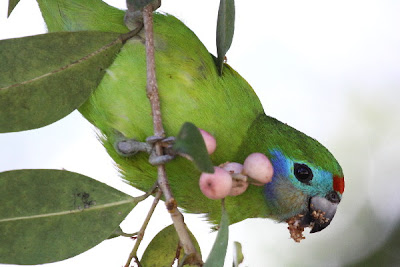
The Double-eyed Fig Parrot Cyclopsitta diophthalma, also known as the Blue-faced Fig, Red-faced Fig, Dwarf Fig and the Two-eyed Fig Parrots, primarily inhabits forests on New Guinea and nearby islands, but is also found in isolated communities along the tropical Australian coast, east of the Great Dividing Range. With an average total length of about 14 cm (5 1/2 in.), it is the smallest parrot in Australia.
Most subspecies of the Double-eyed Fig Parrot are sexually dimorphic, with males having more red (less silvery and blue) to the face than the females. It is predominantly green with a very short tail, a disproportionately large head and bill, and red and blue facial markings. Its name is derived from the cheek patches of some subspecies that vaguely resemble eyes.
different eagles pics

Get latest Animals Pics & Photos

Enter your email address:

Delivered by FeedBurner