Indian Runners don’t waddle like other ducks – they live up to their name and run. They were selected as ‘walking ducks’ in the Far East and evolved a slim, upright body and elongated thigh bone. When foraging or relaxed their posture is flat, but they stand upright to move quickly. In the show pen they are judged on their pure colour, overall stance and shape (type). They must have a keen Runner head, slim shoulders and the typical ‘hock bottle’ shape. They are a light-weight breed of duck at 1.6-2.3kg (3.5-5lb) for drakes and 1.4-2 kg (3-4.5lb) for ducks. Drakes stand around 58-70cm (23-28 in) in height and need a tall show pen,ducks are 60-70 cm (20-24 in.).The food and housing are similar to other ducks, but these birds like space to forage. They also need a secure garden area to start them off – otherwise they can run off in unfamiliar surroundings. This black indian runner ducks are plumage black with a beetle-green lustre throughout and the eyes are dark brown, bill is black.The wings will be black with a beetle-green sheen and underwing dark grey,these ducks legs and webs as black as possible and orange shading permitted in older drakes.The female ducks eyes will be in stripes and life span of this duck 4 to 12years.
Different animals Dogs,Cats,cranes,Elephants,Lions Tigers,Dolphins,Fishes,Peacocks,Goats,deers,crocodiles,ostriches,birds, parrots,Gorillas,butterflies..wallpapers,Funny pictures,Funny videos,Hunting videos and pics,amazing photos of Natural wonders in world,all wonders in world,photographs,images,posters,
Showing posts with label Ducks. Show all posts
Thursday, April 9, 2015
latest photos of black indian runner duck collections
Indian Runners don’t waddle like other ducks – they live up to their name and run. They were selected as ‘walking ducks’ in the Far East and evolved a slim, upright body and elongated thigh bone. When foraging or relaxed their posture is flat, but they stand upright to move quickly. In the show pen they are judged on their pure colour, overall stance and shape (type). They must have a keen Runner head, slim shoulders and the typical ‘hock bottle’ shape. They are a light-weight breed of duck at 1.6-2.3kg (3.5-5lb) for drakes and 1.4-2 kg (3-4.5lb) for ducks. Drakes stand around 58-70cm (23-28 in) in height and need a tall show pen,ducks are 60-70 cm (20-24 in.).The food and housing are similar to other ducks, but these birds like space to forage. They also need a secure garden area to start them off – otherwise they can run off in unfamiliar surroundings. This black indian runner ducks are plumage black with a beetle-green lustre throughout and the eyes are dark brown, bill is black.The wings will be black with a beetle-green sheen and underwing dark grey,these ducks legs and webs as black as possible and orange shading permitted in older drakes.The female ducks eyes will be in stripes and life span of this duck 4 to 12years.
Friday, October 24, 2014
latest collection of animal wild muscovy ducks
The Muscovy duck (Cairina moschata) is a large duck native to Mexico, Central, and South America.This ducks have long claws on their feet and a wide flat tail. In the domestic drake (male), length is about 86 cm (34 in) and weight is 4.6–6.8 kg (10–15 lb), while the domestic hen (female) is much smaller, at 64 cm (25 in) in length and 2.7–3.6 kg (6.0–7.9 lb) in weight. Large domesticated males often weigh up to 8 kg (18 lb), and large domesticated females up to 5 kg (11 lb).
The true wild Muscovy duck, from which all domesticated Muscovys originated, is blackish, with large white wing patches. Length can range from 66 to 84 cm (26 to 33 in), wingspan from 137 to 152 cm (54 to 60 in) and weight from 1.1–4.1 kg (2.4–9.0 lb) in wild Muscovys. On the head, the wild male has short crest on the nape and the bill is black with a speckling of pale pink. A blackish or dark red knob can be seen at the bill base, and the bare skin of the face is similar to that in color. The eyes are yellowish-brown. The legs and webbed feet are blackish. The wild female is similar in plumage, but is also much smaller, and she has feathered face and lacks the prominent knob. The juvenile is duller overall, with little or no white on the upperwing.Domesticated birds may look similar; most are dark brown or black mixed with white, particularly on the head.The other colors of ducks such as lavender or all-white are also seen. Both sexes have a nude black-and-red or all-red face; the drake also has pronounced caruncles at the base of the bill and a low erectile crest of feathers.Although this duck is a tropical bird, it adapts well to cooler climates, thriving in weather as cold as −12°C (10°F) and able to survive even colder conditions.for cute pics......
Thursday, August 7, 2014
latest collections of animal runner ducks photos
Indian Runners (Anas platyrhynchos domesticus) are an unusual breed of domestic duck. They stand erect like penguins and, rather than waddling, they run. The females usually lay about 150 – 200 eggs a year or more, depending whether they are from exhibition or utility strains. They were found on the Indonesian Islands of Lombok, Java and Bali.These ducks does not fly and rarely form nests and incubate their own eggs. They run or walk, often dropping their eggs wherever they happen to be. Duck-breeders need to house their birds overnight or be vigilant in picking up the eggs to prevent them from being taken by other animals.This ducks vary in weight between 1.4 and 2.3 kg (3-5 lbs)and their height (from crown to tail tip) ranges from 50 cm (20 inches) in small females to about 76 cm (30 inches) in the taller males. The eggs are often greenish-white in color, but these too vary.
The indian runner ducks also like swimming in ponds and streams, but they are likely to be preoccupied in running around grassy meadows looking for worms, slugs, even catching flies. They appreciate open spaces but are happy in gardens from which they cannot fly and where they make much less noise than call ducks. Only the females quack. All drakes are limited to a hoarse whisper. Runners eat less in the way of grain and pellet supplement than big table ducks.for cute pics....
Thursday, July 17, 2014
cute pictures of animal magpie ducks information
The Magpie duck is a lightweight breed of domesticated duck. Developed in the early 20th century, they are raised as general purpose ducks, since they have attractive markings, and are highly productive layers of large eggs.These are black and white plumage, reminiscent of the colouration of the European Magpie, the typical example of the species is predominantly white with two large black areas on the back and top of the head. As the bird ages the black cap will normally begin to be flecked with white and may eventually become completely white.Similar in shape to the Khaki Campbell, but more substantial, the Magpie is moderately streamlined with a somewhat upright carriage that suggests indian runner duck in its ancestral bloodline. The bill is yellow or orange, but turns green in older birds. The legs and feet are orange but may be mottled. The chest is rounded and the neck moderately long.
Males have fully feathered, curled feathers on the tail. Females have, when fully feathered, straight feathers on the tail. Males weigh around 2.7 kg (6 lb) on average, and females around 2.5 kg (5½ lb), although the American standard specifies 1 lb (0.45 kg) lower for each. They lay between 220–290 large green/blue eggs annually. They are a hardy variety, active foragers, and live for approximately 9 to 12 years. While generally at home on land and not capable of sustained flight, they can propel themselves over a 2-3 foot wall if startled.
Magpie ducks are often a docile and calm breed, especially when handled regularly. Individuals can be high-strung. Regular handling from a young age will ensure your Magpie ducks are friendly and easy to manage.Magpies will graze and hunt for a sizable portion of their feed from grass, seeds, insects, and aquatic life. They eagerly search for and consume slugs, snails, and insects; so much so that keepers of large livestock find that these ducks are effective at eliminating liver fluke infestations.Duck eggs may be hatched naturally by placing them under a broody duck or even a broody chicken hen.This ducks are very good setters, capable of hatching 12-15 duck eggs. The nest box should be located in a clean dry shelter, bedded with suitable litter.If eggs are stored for a while before they are set, they should be stored at a temperature and humidity level that will minimize deterioration of the egg. For a small number of eggs, storage in a cellar may suffice. Whenever possible, store eggs at about 55°F (13°C) and 75% of relative humidity. Store eggs small end down.for cute pics....
Friday, June 6, 2014
wildlife animals of little pied comorant photos
The Little Pied Cormorant is a benthic feeder, i.e. it finds its prey on the sea floor. It is a solitary feeder, normally diving in relatively shallow water, often near the shore. Dive times are short, around 15 to 20 seconds, with recovery times on the surface of 5 to 10 seconds unless prey are being swallowed. It takes a variety of fish prey but an unusually high proportion (nearly 30% by weight on average, and up to 80% in some individuals) of crustaceans. In New Zealand waters it is most often seen preying on the local flounder and other small flatfish. Eels and insect larvae are also consumed. These are brought to the surface to be swallowed: the bird will sometimes put a fish down on the surface of the water in order to re-orient it and swallow it head first. Because of this habit, they suffer some kleptoparasitism from Red-billed Gulls.The breeding occurs once a year in spring or early summer in southern areas of its range (southern Australia and New Zealand), and after the monsoon in tropical regions. The nest is a platform built of branches and sticks, often still green with leaves in the forks of trees, usually eucalypts that are standing in water. Nests are often located near other waterbirds such as other cormorants, herons, ibis or spoonbills. Four or five pale blue oval eggs measuring 46 x 31 mm are laid. The eggs are covered with a thin layer of lime, giving them a matte white coated appearance. They become increasingly stained with feces, as does the nest, over the duration of the breeding season.for more pics....
Friday, April 18, 2014
fantastic pics of american white pelican ducks
American White Pelicans like to come together in groups of a dozen or more birds to feed, as they can thus cooperate and corral fish to one another. When this is not easily possible – for example in deep water, where fish can escape by diving out of reach –, they prefer to forage alone. But the birds also steal food on occasion from other birds, White pelicans are known to steal fish from other pelicans, gulls and cormorants from the surface of the water and, in one case, from a Great Blue Heron while both large birds were in flight.The birds arrive on the breeding grounds in March or April; nesting starts between early April and early June. The nest is a shallow depression scraped in the ground, in some twigs, sticks, reeds or similar debris have been gathered. After about one week of courtship and nest-building, the female lays a clutch of usually 2 or 3 eggs, sometimes just 1, sometimes up to 6.Both parents incubate for about 4 weeks to one month and the young leave the nest 3–4 weeks after hatching; at this point, usually only one young per nest has survived.for more images...
Wednesday, May 29, 2013
latest videos of animal white cheeked pintail duck gallery
latest videos of animal white cheeked pintail duck poster
african animals of white cheeked pintail florida photos
wallpapers of cute baby white cheeked pintail duck gallery
free downloading pics of white cheeked pintail galapagos wiki
different types of flying white cheeked pintail youtube
beautiful images of white cheeked pintail ducks gallery
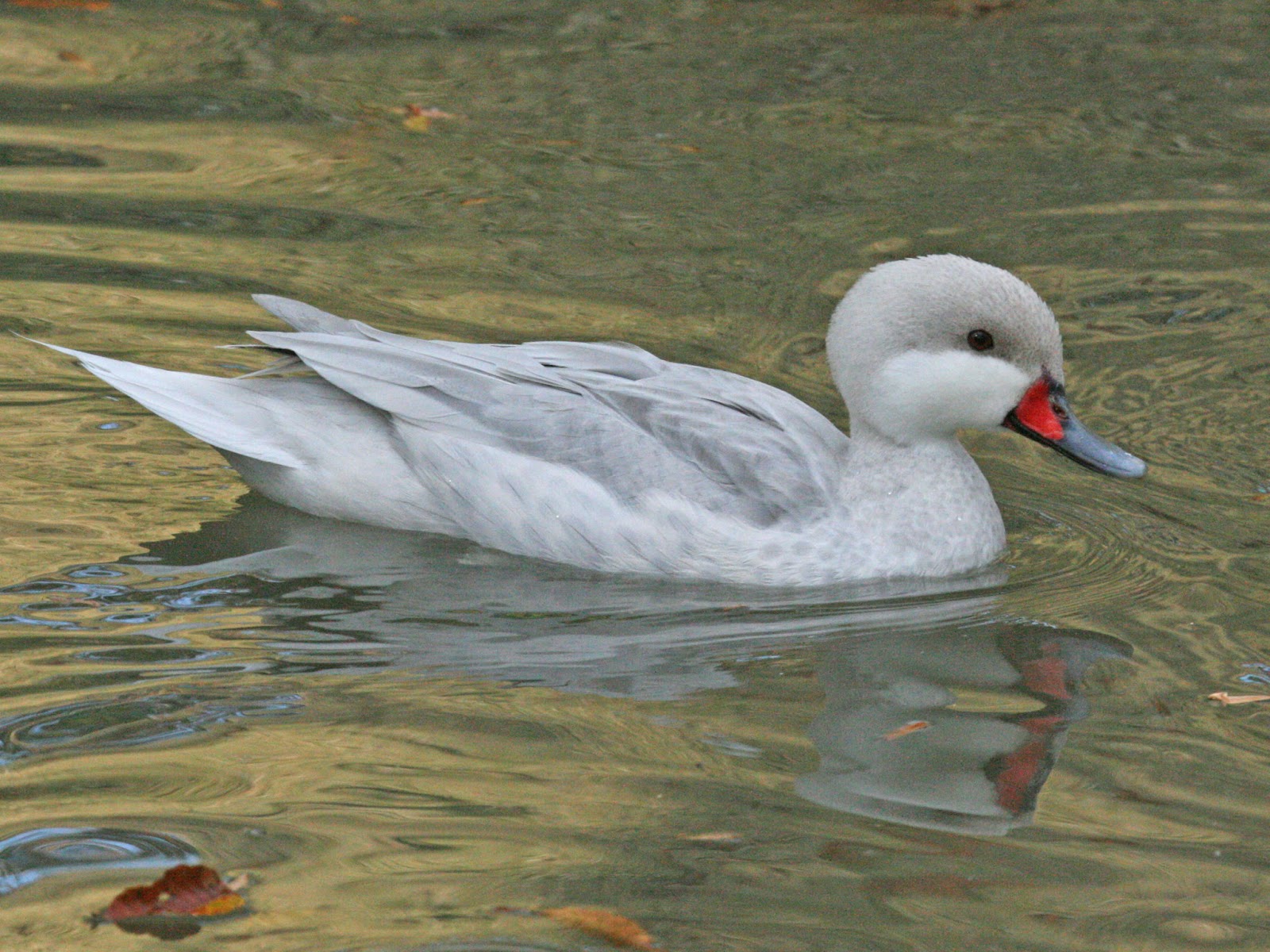
The crown and hindneck of the male white-cheeked pintail are medium-brown and weakly mottled. The sides of the head, throat and upper foreneck are pure white. The remainder of the body plumage is mostly warm medium-brown and spotted with black on the breast and underparts. The upperparts have black feather centers. The uppertail and undertail coverts and pointed tail are a warm buff. The upperwing coverts are brown, with buff tips to greater coverts. Tertials are somewhat elongated, pointed and blackish with pale-brown fringes. Secondaries have a narrow metallic-green basal band, black subterminal border and very wide buff terminal band. The underwing is dark, with a paler central band, blackish underside to flight feathers, pale trailing edge and white axillaries. He occasionally utters a low whistle. The female is white of face and bill coloration a little duller than the male, and is also a little smaller, with a shorter tail.
The White-cheeked Pintail feeds on aquatic plants and small creatures obtained by dabbling. The nest is on the ground under vegetation and near water.The duck is a yearlong resident of fresh to hypersaline bodies of water. Pair bonds are formed soon after the post-breeding molt. Breeding season is from February to June, but varies depending upon rainfall and availability of invertebrates. Nests are made of a scrape on dry land concealed under a clump of vegetation, sometimes a great distance from water. Hens may lay between 5-12 light tan eggs.for more images....
african animals of white cheeked pintail florida photos
wallpapers of cute baby white cheeked pintail duck gallery
free downloading pics of white cheeked pintail galapagos wiki
different types of flying white cheeked pintail youtube
beautiful images of white cheeked pintail ducks gallery
Sunday, March 17, 2013
wallpapers of animal bar headed geese gallery
wallpapers of animal bar headed geese poster
beautiful images of animal bar headed geese gallery
free downloading bar headed geese fly over the world's highest
latest videos of bar headed geese ducks wikipedia
Indian animals of bar headed geese with baby youtube
The Bar-headed Goose is one of the world's highest-flying birds,having been heard flying across Mount Makalu – the fifth highest mountain on earth at 8,481 m (27,825 ft) – and apparently seen over Mount Everest – 8,848 m (29,029 ft) – although this is a second-hand report with no verification.This demanding migration has long puzzled physiologists and naturalists: there must be a good explanation for why the birds fly to the extreme altitudes... particularly since there are passes through the Himalaya at lower altitudes, and which are used by other migrating bird species.In fact, bar-headed geese have never been directly tracked (using GPS or satellite logging technology) flying higher than 6,540 metres (21,460 ft), and it is now believed that they do take the high passes through the mountains. The challenging northward migration from lowland India to breed in the summer on the Tibetan Plateau is undertaken in stages, with the flight across the Himalaya (from sea-level) being undertaken non-stop in as little as seven hours. Surprisingly, despite predictable tail winds that blow up the Himalayas (in the same direction of travel as the geese), bar-headed geese spurn these winds, waiting for them to die down overnight.This bird is pale grey and is easily distinguished from any of the other grey geese of the genus Anser by the black bars on its head. It is also much paler than the other geese in this genus. In flight, its call is a typical goose honking. A mid-sized goose, it measures 71–76 cm (28–30 in) in total length and weighs 1.87–3.2 kg (4.1–7.1 lb).
for different pics....
beautiful images of animal bar headed geese gallery
free downloading bar headed geese fly over the world's highest
latest videos of bar headed geese ducks wikipedia
Indian animals of bar headed geese with baby youtube
Wednesday, February 20, 2013
wallpapers of cute animal pink pelican poster
wallpapers of animals pink pelican gallery
latest videos of animal pink pelican promo code
free downloading pics of pelican duck wiki
famous pictures of animal pink pelican huntsville
different types of animal pink pelican florist youtube
The Pelican breeds from southeastern Europe through Asia and in Africa in swamps and shallow lakes. Their tree nest is a crude heap of vegetation. This is a large pelican, at a mass of 10 kg, 160 cm long and with a 280 cm wingspan. Pelicans catch fish in their huge bill pouches while, like most, swimming at the surface. This species has declined greatly through habitat loss and persecution.his is a small pelican, but its wingspan is still around 2.4 m (7.9 ft) and its average weight is 5.5 kg (12 lbs). Plumage is grey and white, with a pink back. The top of the bill is yellow and the pouch is usually grayish. Breeding adults have long feather plumes on the head.latest videos of animal pink pelican promo code
free downloading pics of pelican duck wiki
famous pictures of animal pink pelican huntsville
different types of animal pink pelican florist youtube
The main food of pink-backed pelicans is fish. In addition, they feed on a variety of small invertebrates and amphibians. They usually fish in groups, stretched out in a line to surround a shoal of fish. The pelicans then duck their heads under water at exactly the same time, frightening and confusing the fish which are scooped up in the birds’ pouches.The species nests colonially in trees, reeds or low bushes along waterfronts as well as (less often) on the ground on sandy islands and in mangroves. The nest is small and constructed of sticks, and may be situated at elevations of 10-50 m above the ground. A single tree may contain many nests that can be very close together (often touching), and a single pair will refurbish and re-use the same nest from year to year if it has not collapsed.
Pelicans swim well with their short, strong legs and their feet with all four toes webbed (as in all birds placed in the order Pelecaniformes). The tail is short and square, with 20 to 24 feathers. The wings are long and have the unusually large number of 30 to 35 secondary flight feathers. A layer of special fibers deep in the breast muscles can hold the wings rigidly horizontal for gliding and soaring. Thus they can exploit thermals to commute over 150 km (100 miles) to feeding areas.for more pics.....
Sunday, June 5, 2011
latest images of animal stellers eider ducks gallery

latest images of animal stellers eider ducks gallery
videos of water animal stellers eider ducks
free downloading pics of steller eider wiki
wallpapers of stellers eider ducks habitat
The Steller’s eider (Polysticta stelleri), one of four types of eider ducks, is a marine bird residing in arctic and sub-arctic regions. This sea duck spends most of its time in shallow coastal waters though will move inland, in cases over 200 miles, to breed. There are three breeding populations currently recognised – two in Russia (Atlantic and Pacific populations) and one in Alaska. The Alaskan breeding population is predominantly found on the Arctic Coastal Plain (northern Alaska) centered around Barrow though a very small sub-population of breeders is found in western Alaska on the Yukon-Kuskokwim (Y-K) Delta. It is estimated that there are over 150 000 birds in the Russia-Pacific population, some 30 000 to 50 000 in the Russia-Atlantic population, and around 10 000 in Alaska.
The stellers eider body boldly patterned in black, white, and buffy, and its white head with green and black markings, the fancy male in breeding plumage is unmistakable. In all other plumages, however, Steller’s Eider looks rather like a small, plain, dark-brown dabbling duck. The best clues to its identity are its short neck and flat-topped head. Unlike the other eider species, it has no feathering on the bill.To see more pics......
Subscribe to:
Posts (Atom)